There was a young lady named Bright,
Who traveled much faster than light;
She set out one day in a relative way,
And came back on the previous night.
Scientists in Shock After Breaking Speed of Light
This is amazing, if proven true: A fundamental pillar of physics – that nothing can go faster than the speed of light – appears to be smashed by an oddball subatomic particle that has apparently made a giant end run around Albert Einstein’s theories. The full articlehere.
Friday, June 3, 2011
Happy Friday :) A few jewels before we get to the second part of our African Lion Safari tour. A faithful reader forwarded me this video. I don't think I would have envisioned this design if I'd tried. Innovation never stops - I guess it is at the heart of man.
In science/space news, the uncanny resemblance of a galaxy about 30 million light years
away from Earth, to our own Milky Way has astounded astronomers.
This is the best-yet picture of NGC 6744, a spiral galaxy described as a "sibling" of our own Milky Way.
The image was snapped by the European Southern Observatory's MPG/ESO 2.2-metre telescope in Chile.
The galaxy lies 30 million light-years away, in the constellation Pavo.
While it is almost twice as large as the Milky Way, it exhibits the same sharply-defined spiral arms and stretched central region.
There is even a small companion galaxy, visible at the lower right of the image, which is analogous to our own galactic neighbours the Magellanic Clouds.
Those arms host many star-forming regions; the glow coming from hydrogen gas in these active regions shows up as red in the image.
This is the second installment in our African Lion Safari tour
(a backrest on a chair in the restaurant)
Fyi: the monkey in the background is playing with someone's side mirror..!
Hate to admit it, but I am not the Monkey's biggest fan!
Perhaps we are the main attraction but don't realize it?
The ostrich above was chasing off one of these characters.
These guys made me kind of nervous...
They could make mincemeat out of any vehicle.
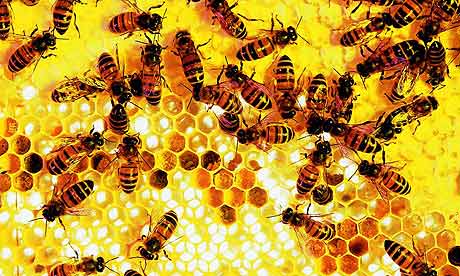
Researchers found that bees could solve the 'travelling salesman's' shortest route problem, despite having a brain the size of a grass seed. Photograph: Rex Features
Bees can solve complex mathematical problems which keep computers busy for days, research has shown.
The insects learn to fly the shortest route between flowers discovered in random order, effectively solving the "travelling salesman problem" , said scientists at Royal Holloway, University of London.
The conundrum involves finding the shortest route that allows a travelling salesman to call at all the locations he has to visit. Computers solve the problem by comparing the length of all possible routes and choosing the one that is shortest.
Bees manage to reach the same solution using a brain the size of a grass seed.
Dr Nigel Raine, from Royal Holloway's school of biological sciences, said: "Foraging bees solve travelling salesman problems every day. They visit flowers at multiple locations and, because bees use lots of energy to fly, they find a route which keeps flying to a minimum."
Using computer-controlled artificial flowers to test bee behaviour, his wanted to know whether the insects would follow a simple route defined by the order in which they found the flowers, or look for the shortest route.
After exploring the location of the flowers, the bees quickly learned to fly the best route for saving time and energy.
The research, due to appear this week in the journal The American Naturalist, has implications for the human world. Modern living depends on networks such as traffic flows, internet information and business supply chains.
"Despite their tiny brains bees are capable of extraordinary feats of behaviour," said Raine. "We need to understand how they can solve the travelling salesman problem without a computer."